Showing posts with label storage. Show all posts

Thursday, October 15, 2015

Children's Artwork . . . keeping it on display

What did you like to draw when you were a kid? From the time a child can pick up a crayon and scribble on paper (maybe the wall) it is interesting to see. All first scribbles, squiggles and doodles are forms of expression. Ever wonder what is on their little minds while they draw and see the outcome? Are the drawings some kind of clue to the child’s future?

For example, this drawing of a train by
my husband Keith when he was in first grade, shows his attention to detail. He did not become an engineer, but his love for trains was passed onto his son Charlie.

Though Charlie loved to watch the trains come into the station and he always waved to the engineer when a train passed by, his love was ships. He first drew submarines, then ocean liners. This drawing was found in a Father’s Day card Charlie gave to his dad. Charlie did not go on to have a career at sea, but gave him the love of reading travel and adventure books.

The juggler was drawn by our daughter Tif. She would watch her father juggle and this was her interpretation. Her love of expressive art has given her many hours of drawing
pleasure and she now passes on her talents to children as a teacher. As for me, the only picture I could find was this drawing of a little girl jumping rope. Self-portrait? Perhaps.    

There is so much written on the subject of art that it is truly mind-boggling. But whatever those early images are, they should be saved. And more importantly, to save as much as you can because it is truly amazing to see first-hand how artistic minds are expressed and developed.
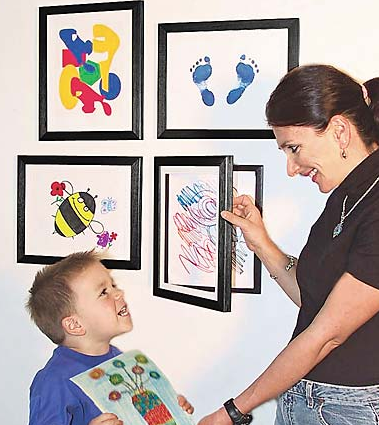
Today, that are many products that you can purchase for the preservation of artwork. As this blog is focused on a child’s work, the display and storage units vary in size and use. Like these individual frame boxes in which you can both display and store pictures. These units come in various sizes and should be hung on the walls of different rooms, not just the child’s bedroom. By displaying their artwork in public areas of the home, the child can feel proud that his family takes much pride in him or her by showing off their artistic talents.

 Another storage idea is a multi-drawer cardboard box that stores many papers including school work and school mementoes. When artwork becomes larger in size and multiple in quantity, having a unit like this swinging panel that flips open like a book will present artwork in a movable display.

Whatever presentation method you use, it will give both the artist and the observer hours of pleasure and pride. For these and more products ideas, check out Blick art supplies & Michaels arts & crafts.

Friday, August 7, 2015

Blog to Book . . .

Hi everyone. Thanks for reading my blog How to Create a Family Museum.  

The purpose of the blog is to inspire, encourage and motivate you on how to preserve, protect and display your family’s history. It is vitally important to do so, and if you have yet to do so, start today. It is only too late if your history has been disposed of; and I am not talking just about things like souvenirs, collectibles, objet d'art, novelties, bits and pieces, odds and ends – another word stuff, if that word rings a more familiar bell. I am talking about all of these things and more; the everyday things used in the past and present that need to be saved for the future, because it is history, your history, and all of it has a story to tell – your story. 
I have been writing this blog for over a year, however, compared to some who have been writing their blogs for years, my time is not very long. But that’s OK. All of my posts are thoughtfully written and visually educational. As of this date, there are 116 posts covering everything you need to know on how to create your family museum. Being traditionally minded, I am conservative when it comes to social networking sites, so as the saying goes, “I have put all of eggs in one basket,” my blog. However, it is now time that I count those eggs and turn them into pages in a book to expand my message and help you save your history.
Now, I am not talking about another how-to book on home organization, storage, de-cluttering, downsizing, re-purposing, etc. Though there is a plethora of advice in those books, as well as online help, in newspaper articles and on television shows, they all have one thing in common – establishing some orderliness in your life and home. That’s good and necessary to keep your living space clean or organized, however, by doing so you may, even sometimes unintentionally, throw away, get rid of, or donate something near and dear to you or someone else, resulting in a loss of valuable memories and memoirs that literally make you who you are.
So as you organize whatever mess, clutter, disorder, jumble and jam, and are needing to confront, face up to, tackle head on, and deal with, this is the time to set aside your precious things and create a place in your home, even your office, that is designated as a showplace, a personal museum, that will display, protect, and preserve your history.
I truly believe making a book available to my readers with all the how-to instructions, pictures, renderings and narratives that appear on my blog will guide you to creating this very special place in your home and in your family’s life. Once the book is published, it will be available for purchase at bookstores and online booksellers which I will provide links to. And I will continue to write my blog offering edifying information and entertaining quips that keeps on inspiring and encouraging you to create your family museum.      
Please and thank you for your support and comments.   Liz 
 
(Mockup of cover design; subject to change)  


Saturday, August 30, 2014

Our "Family Museum" Story

One day my dear friend Barbie accompanied me to the attic. As I rearranged once again stacks of boxes to make room for more, she laughed when she spotted a box labeled,
    "Charlie’s Memorabilia"
She asked, “How could Charlie already have a box of memorabilia when he is only two years old?” Laughing, I said, “Open it.” 

She did and was surprised to see I had saved not only the usual
baby shoes, she saw his teething ring, a tiny box with his baby teeth, first tiny diaper, Christening gown, rattles and photographs. As she closed the box, I could see a melancholy expression on her face. She said softly, “I kept Christy’s baby shoes but not Ryan’s. I never thought to keep the things you did.” Then she laughed. “And baby teeth! Ryan swallowed his and I think my grandmother kept some of Christy’s, but their gone now.”

Handing the box back to me, she asked, “What are you going to do with all this stuff you are saving?” Feeling overwhelmed as I gazed upon the stacked boxes, I was not at all sure what to do. A couple of years later, push came to shove and I had to do something about all those boxes.  

My father had a stroke and my mother was terrified of taking care of him herself.  

After much soul-searching, my husband, Keith, and our kids Tiffeni & Charlie
offered to turn the attic into an apartment for them. Because Keith built our home, some areas were still a work-in-progress, particularly the front hall. We did not know what style staircase we wanted, so we did not build it since there was one in the kitchen. Because there were no stairs in the hall, we installed an elevator for my father who now had to be in a wheelchair.
 
When finished, the attic became a private two-bedroom, handicap bathroom, full kitchen and a living/dining room apartment. It was quite commodious and with the ease of the elevator, dad was able to ride it down to the basement where we had set up a workshop filled with all his tools and gadgets so he could entertain himself.
 
So what happened to all those boxes? It was a conundrum. We piled the boxes in the guest bedroom, which was also my office. We piled boxes in the kids bedrooms, hallway and laundry room. As we placed these cubicles of souvenirs’ into stacks, I looked into each box to see what exactly was in it. Oh my goodness! Talk about memories. Each of us was stunned to see stuff we thought long gone and were thrilled to see again. I will not describe here all the emotions displayed, but rest assured there were plenty. So what did we do next? Organize! 
 
As we opened a box and saw what was in it and to whom the stuff belonged, we put the box in that person’s room and labeled it with their name and description of the contents. This was the best time to consider what were the most important things to continue saving. Box-by-box everyone had a hand in creating their own preservation. But what to do after we organized it all was still a dilemma. Then I got a clue by way of a very unexpected discovery.
 
One day Tiffeni and I took a trip offered by the Chrysler Museum to the Reynolda House Museum of American Art in Winston-Salem, North Caroline. Built in 1917 by Katharine Smith 
Reynolds and her husband R.J. Reynolds, founder of the R.J. Reynolds Tobacco Company, the home displayed a premiere collection of American art ranging from the colonial period to the present. The museum had restored interior rooms and furnishings to reflect the periods when the family lived there. Reynolda House features a gallery space for traveling exhibitions. There are usually two shows featured in that space every year, one in the fall and one in the spring.
 
There are other exhibitions throughout the year in the Northeast and West Bedrooms in the house. Not only in the bedrooms but in the attic where a wide hallway was lined with glassed-in mini rooms that displayed delightful items, from
clothing to jewelry, sports equipment, toys, music, photographs and more.
 
That is when I came up with the idea of a family museum. If the Reynolda family can take areas in their home to display their precious memorabilia, then so could my family! 

                                        
Next Post: Back to Our House


Monday, August 25, 2014

Closets & Shelving

Find a closet that is not already filled to the gills? An extra closet? I have to be kidding. Right? Well, I thought the same way. My closet space was minimal and stuffed to the maximum. After I brought down everything from the attic, the boxes lived in the hallway for weeks. It was a daunting task to divide and conquer, and to find everything a place and a place for it all. My toes begged me to do something about it after they suffered numerous collisions with the boxes.

The trick about taking an overstuffed closet and turning it into display space for your family museum is having some kind of space to transfer the closet’s paraphernalia. To meet the demands of both ample closet space and sufficient space for display purposes, invest in shelving, wall cabinets and/or module closet systems. All offer many options and designs for the closet space to be configured and adapted into a display unit. Custom-built shelves can be placed in other rooms: laundry, bathroom, other closets, the basement, attic, and the garage for storage.
           
Linen closets make the best space for a museum because they already have shelves and lighting. After you cleared it out, if the shelves are wire, replace them with solid shelving boards. Replace standard sliding closet doors with decorative interior or bi-fold French glass doors. This allows for viewing and the light from within illuminates the hallway. 

By combining form and function with extraordinary design, reach-in and walk-in closets can be transformed into an organized display and storage of family heirlooms instead of a dysfunctional space. Where ever you create your family museum, it will be an inspiring and gorgeous space that will bring a visually stunning and timeless beauty to your home. 

And don’t forget to hang a sign embellished with Your (Family Name) Museum.


Next Post: Any Room/Space with Custom-built Units