Take a walk around your house, apartment, condo, where ever you call home. Pay attention to all spaces, particularly those that are not used. For example, a guest bedroom, hallways, even closets. Living and dining rooms may have a modicum of space, as well as the family room. Assess the space. What is in there now? How is it used? Can it be changed? Or can you eliminate what there is now and/or moved it to a better place in the house?
If one, a few or all of these suggestions can be done, after you have mentally envisioned the empty space, imagine a bookcase, china or curio cabinet there. Furniture pieces make great family museums. Perhaps you already have this type of furniture in your home that is filled with books, dishes, or a specific collection. If you are satisfied with this, then let it be. However, if you take off some of those books and incorporate other items such as photographs, personal belongings of the person whose books are on the shelf, or along with those dishes add a photograph of the special occasion where you used those dishes, maybe adding the invitation to the event. With that special collection in the curio cabinet perhaps you can include a picture of the person who owned the item. What is happening here is that you are developing a more in-depth look at not only the thing, but it's history.
My first intention was to put my family museum up in the attic. It was a commodious space, but it needs to be air conditioned in the summer. Heat is not good for antiques and heirlooms. Notice how cold it is in a museum? However, that plan did not happen. We chose to convert the attic into an apartment for my disabled parents. Though we lost that space, we were able to have my parents live with us in their twilight years.
After bringing down all the boxes from the attic and going through cherished items that were stored for years, I was overwhelmed. What should I keep and where do I put it all? The only space available was converting a linen closet (story to follow). Cleared of everything that was in it, using every nook, corner, cranny and niche, incorporating shelving and cabinets where there was room, and after painting the walls, building shelves and making curtains, our family museum was created.
Then came the real challenge. Selecting what went into the museum, displaying it with thought and care, and parting with those things not wanted. That was difficult, however, donating the things to a worthy cause took the angst out of giving the items away. The total time it took me to place everything in the museum is irrelevant. The putting in and taking out, the arranging and rearranging, have no time restraints. There is no limit to how long it will take to create your family museum because it really is an ongoing project. Like life!
Everyday you encounter new experiences, new knowledge, sometimes new things. And the memories keep growing. You may not put in your museum what you accumulated that day. You may not do it for a week, a month, or longer. But that is OK. There is no schedule. No deadline. For me, there were many times that I did not attend to my family museum. So I let the things pile up, slid them in, put it where ever I found the room. Eventually, the museum did not look so fine and that's when I pushed up my sleeves and organized. And as I did, I changed things, put some of the heirlooms away, and in the process, found new ways to display the things I love.
So have no fear. You will find the place and space for your family museum.
"Every cubic inch of space is a miracle."
Walt Whitman
Next Post: How to organize the heirlooms - finding, selecting, displaying
 For example,
this drawing of a train by
For example,
this drawing of a train by Though Charlie loved to watch the trains come
into the station and he always waved to the engineer when a train passed by,
his love was ships. He first drew submarines, then ocean liners. This drawing
was found in a Father’s Day card Charlie gave to his dad. Charlie did not go on
to have a career at sea, but gave him the love of reading travel and adventure
books.
Though Charlie loved to watch the trains come
into the station and he always waved to the engineer when a train passed by,
his love was ships. He first drew submarines, then ocean liners. This drawing
was found in a Father’s Day card Charlie gave to his dad. Charlie did not go on
to have a career at sea, but gave him the love of reading travel and adventure
books. 
 The juggler was drawn by our daughter Tif. She would watch her father
juggle and this was her interpretation. Her love of expressive art has given her
many hours of drawing pleasure and she now passes on her talents to children as
a teacher. As for me, the only picture I could find was this drawing of a
little girl jumping rope. Self-portrait? Perhaps.
The juggler was drawn by our daughter Tif. She would watch her father
juggle and this was her interpretation. Her love of expressive art has given her
many hours of drawing pleasure and she now passes on her talents to children as
a teacher. As for me, the only picture I could find was this drawing of a
little girl jumping rope. Self-portrait? Perhaps. 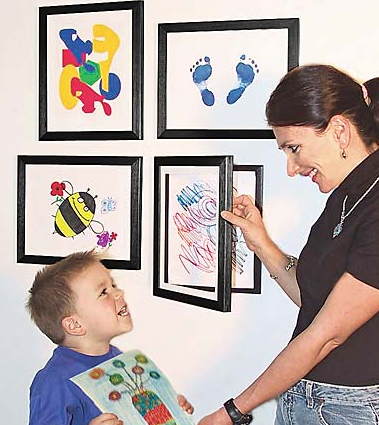

 Another storage idea is a multi-drawer cardboard box that
stores many papers including school work and school mementoes. When artwork
becomes larger in size and multiple in quantity, having a unit like this
swinging panel that flips open like a book will present artwork in a movable
display.
Another storage idea is a multi-drawer cardboard box that
stores many papers including school work and school mementoes. When artwork
becomes larger in size and multiple in quantity, having a unit like this
swinging panel that flips open like a book will present artwork in a movable
display. 


